

Finding the Obvious
The power of thinking and how most people avoid it

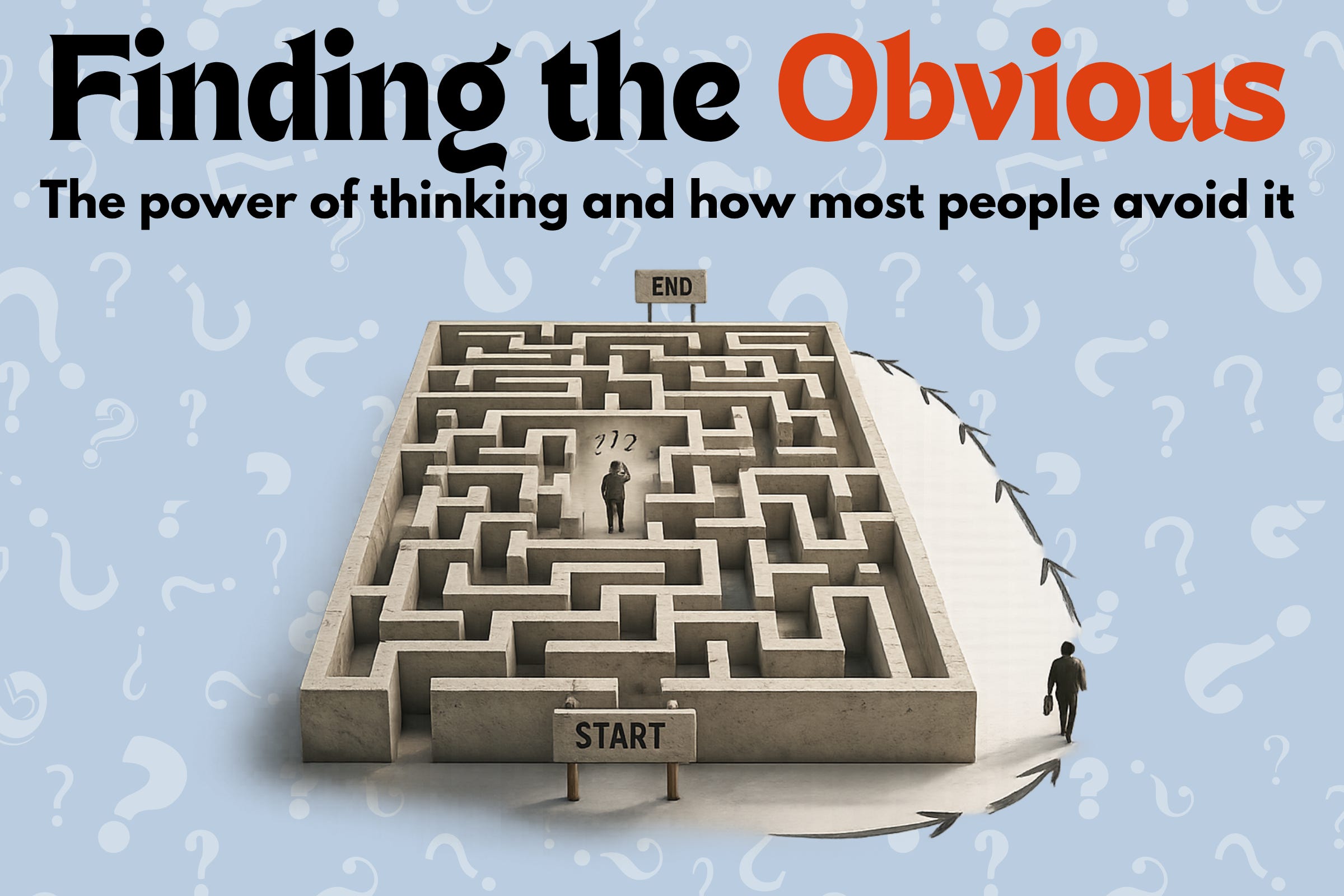
Obvious Adams: The Story of a Successful Businessman may be the most valuable 141 pages you can read. It’s about how the obvious action is actually hard to see, and finding it requires you to think — a process often avoided. The art of thinking and finding the simple is what I want to land with you here. I will get there through the short biograpahy of Adams, bear with me, I promise its worth it.
Adams, an advertising exec, first suggested that when advertising a hat in a magazine, they should use a close-up of the hat being worn, rather than a picture of the full person! A crazy idea back then (the book was published in 1916), but so entirely obvious to us now.
From Obvious Adams
”Well, Mr. Oswald, I have decided that I want to get into the advertising business and that I want to work for you, and I thought the obvious thing to do was to come and tell you so. You don’t seem to think I could make good and so I will have to set out to find some way to prove it to you. I don’t know just how I can do it, but I’ll call on you again when I have found out. Thank you for your time. Good-bye.” And he was gone before I could say a word.”
…
“It all struck me in a heap: How many of us have sense enough to see and do the obvious thing? And how many of us have persistency enough in following out our ideas of what is obvious? The more I thought of it the more convinced I became that in our organization there ought to be some place for a lad who had enough sense to see the obvious thing to do and then to go about it directly, without any fuss or fireworks, and do it!”
The parallels are apparent, or obvious 😉. In business, we forget to ask our users and just guess what they might want. Michael Seibel talks about the early days of Twitch2, where they asked their streamers and immediately got back, “Can you let us stream in higher resolution?” Something so obvious and easy to implement it was embarrassing they hadn’t thought of it (though it would increase their costs). Later, streamers asked, “Can you help us make money?” leading to revenue sharing of advertising, now a huge part of most popular social media platforms.
ChatGPT was obvious. Capable LLMs were around at least a couple of years before ChatGPT, they were just harder to use, being trained to complete text rather than answer questions. But it was only obvious to everyone after it was released.
I realised a lot of my career has been doing the obvious and being confused about why others aren’t. I have been called strange; I have taken people aback, but nearly always, after explaining my reasoning or motive, the action was understood and ultimately very effective.
In a recent project, I made it much easier to run jobs in Spark, while increasing parallelisation and saving money. Big numbers — one pipeline was an 80 percent cost reduction and completes in a fraction of the time. The idea was obvious, but before I built it, the common response was “It feels like there should be a better way” (a good challenge) and “We shouldn’t have to do that” (I agree). But when there wasn’t a better way, and we did have to do it, most shied away instead of doing the obvious thing in front of us.
Another Adams story raises the issue that we expect complexity in ideas.
“The president looked them over and grunted. Plainly he was disappointed. Adams’s heart sank; he was going to fail on his first selling trip, but not without a fight.
The president rocked back and forth in his chair for a few minutes. Young man,” he said, finally, “every good bond paper is made of carefully selected rags”—quoting from the advertisement in his hand; “every good bond paper is made with pure filtered water; every good bond paper is loft-dried; all good papers are hand inspected. I didn’t need to get an advertising man from New York to tell me that. What I wanted was some original ideas. Every one knows these things about bond paper.”
“Why, is that so?” said Adams. “I never knew that! Our agency controls the purchase of many thousands of dollars’ worth of bond papers every year, yet I venture to say that not a single man in our organization knows much about paper-making, excepting that good paper is made of rags. You see, Mr. Merritt, we aren’t any of us paper-makers, and no one has ever told us these things. I know there is nothing clever about these advertisements. They are just simple statements of fact. But I honestly believe that the telling of them in a simple, straightforward way as qualities of your paper, month after month, would in a comparatively short time make people begin to think of yours as something above the ordinary among papers.”
No fancy copy, no clever or abstract ideas. The reaction: “I didn’t need to get an advertising man from New York to tell me that.” Have we all just been burned by the reactions of others when we’ve done the obvious? Do we overcomplicate things because that’s what people expect?
We need to defend and fight for ideas when they are obvious more often than when they are complex. Complexity is somehow more valid, more trusted than simplicity. There must have been more thought and reason put into the complex, surely? But the opposite is true.
I think many end up hiding behind complexity simply because it isn’t questioned. But when you have really taken the time to understand, think, and have a clear course of action, you can defend it, and you can break through.
“Mr. Merritt was evidently impressed by the logic of Adams’s argument, yet he hesitated.
“But we should be the laughing-stock of all the paper-makers in the country if they saw us come out and talk that way about our paper, when all of the good ones make their paper that way.”
The other side is fear. Fear that it must have been tried before and failed. Fear that we are missing something that will make us look stupid if we mention it. Fear of looking stupid is holding so many of us back.
Adams bent forward and looked Mr. Merritt squarely in the eyes. “Mr. Merritt, to whom are you advertising—paper-makers or paper-users?”
That line is a top quote in the book for me because the direct lesson is also so relevant. How often have you had a CEO or executive, far removed from the target market for your product, hold very strong views about a feature or marketing decision simply because it doesn’t appeal to them? They forget it’s not supposed to.
You will finish Obvious Adams in under an hour, but spend far more time in the following days pondering it. The book can be freely obtained, being out of copyright now3.
I leave you with the closing question in Obvious Adams.
“Why don’t more businessmen do the obvious, then?”
“Well,” he said, “since I had that name wished upon me I have given considerable thought to that very question, and I have decided that picking out the obvious thing pre-supposes analysis, and analysis pre-supposes thinking, and I guess Professor Zueblin is right when he says that thinking is the hardest work many people ever have to do, and they don’t like to do any more of it than they can help. They look for a royal road through some short cut in the form of a clever scheme or stunt, which they call the obvious thing to do; but calling it doesn’t make it so. They don’t gather all the facts and then analyze them before deciding what really is the obvious thing, and thereby they overlook the first and most obvious of all business principles.”
Your challenge for the week
Be more like Adams this week.
What’s obvious that you’re not doing?
Follow his process:
Gather the facts.
Throw out that solution that’s already brewing for you.
What do you know? Actually know. What is the evidence?
What don’t you know? Is there anything you can easily find out? How?
Analyse (think!).
Looping and realising you need more fact gathering or another experiment is normal.
What’s the obvious conclusion? Do that!
Advanced: When important decisions are being made, or important information is presented that will be used to make decisions, don’t allow people to hide behind complexity and technobabble.
Ensure you and others understand what’s being said.
Question more than you do with simple information — complexity needs justification.
Say the obvious.
Note: This is advanced because there’s nuance, and I’m presupposing that you know how to challenge without coming across as a jerk.
Let me know what you’re going to try, or how you get on, in the comments!
“Its not 14 pages its 56 pages” - well, yeah, but the pages are like post-it note sized. Stick it on a kindle with normal font size and its about 14
YCombinator: “Secrets you can learn from your customers“ [Youtube] where Michael Seibel discusses twitch
Obvious Adams” free copies
pdf scan of the original book (archive.org)
This really spoke to me. I recently joined Substack and immediately wanted to know how to be successful. I read all of the newsletters and notes, taking in all sorts strategies, road maps, and publishing schedules.
But the obvious answer had been in front of me all along, “just write.”
It feels to be too simple to be true, and thus shouldn’t be trusted, but I do believe that for a new writer like me, the obvious is the correct answer. Thanks for reminding me!